
Preparing for an emergency
Things to think about before something happens
It is very helpful to think in advance about how you would manage a medical emergency and to have some baseline measurements so you can quickly recognise when there is something wrong. Preparing for an emergency is about ensuring you have the skills, equipment and confidence to give immediate help if your pet is sick or injured.
Regularly practice conducting a top to toe examination on your pet.
Start with the head and systematically work down. Build up to more sensitive areas such as they eyes and other areas they may not like being scrutinised. This is really important to help avoid your pet becoming alarmed if you need to properly examine them in an emergency situation. Regular examinations should make it easier for you to swiftly spot any abnormalities.
- Normal range for the vital signs:
- Temperature – 100.5 to 102.5 F or 38-39.3 C
- Respiratory rate 10 – 30 per minute
- Pulse rate 60-140 beats per minute (smaller dogs tend to have a faster pulse rate (possibly up to 160 bpm, large dogs tend to have a slower pulse rate 60-80 bpm)
Establish what is normal for your pet and keep the record safe.
Taking your pet’s temperature: The temperature can be taken using an ordinary digital or rectal thermometer lubricated with some olive oil and gently inserted into their anus with the end touching the inner wall of their anus. This is often easier to do when the animal is sitting, but if they are standing use your free hand to support their stomach and prevent them from sitting.

The easiest place to find the dog’s pulse is in the upper third of their thigh. Place your hand over the top of their thigh and gently squeeze your fingers just underneath their leg, you should be able to feel the artery pulsing here (your thumb has a strong pulse itself so don’t use this to take their pulse as otherwise you will be timing your own pulse rate).
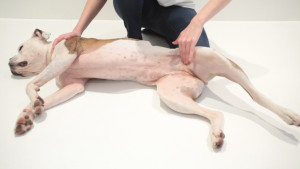
The femoral pulse can be difficult to find on pets with a greater fat covering. You can also listen for a heart beat.
Time the pulse for 15 seconds and multiply the result by 4 to get the beats per minute.
To take their respiratory rate, carefully watch the rise and fall of their chest and count the breaths for a 15 second period – multiply by 4 for the rate for 1 minute.
Capillary refill time – in a healthy animal if you push down on their gums quickly and then release your finger, the colour should return almost immediately in 1-2 seconds. The time it takes for the colour to return is known as the capillary refill time and a slowness for the colour to return could indicate that the animal is going into shock.
Checking mucosal membranes – their gums should be pinky-red, smooth and moist – if they are not they could be going into shock or showing signs of dehydration. Deep red sticky gums are a sign of heat exhaustion.
Your own Vet may not be closest in an emergency. Apps are available to download onto your phone to help you to locate your nearest Vet – click here for more details and to download.
Make sure you have a fully charged mobile phone with you, keep your Vet’s phone number to hand and name of the practice. It is advisable to phone the Practice before you leave as they are likely to be able to suggest additional First Aid that you can do in order to stabilise the animal before bringing them in.
- Ideally keep the injured animal as calm and still as you can, only move them if there is no other option in order to keep everyone safe and get veterinary help.
- A suitably sized pet carrier that your pet is used to sitting or travelling in is the safest way to transport them to the vet.
- Put a favourite toy or blanket in the carrier with them as familiar objects will reduce the amount of stress that they are experience.
- It is critically important to continually reassure your pet as stress can make symptoms worse.
Keep them calm and warm. Ideally they should not have anything to eat or drink as they may require an operation. However if they are dehydrated, or they could be waiting a considerable time for help, you should give them small sips of water. Ideally check with your Vet first.
First Aid for life provides this information for guidance and it is not in any way a substitute for medical or veterinary advice. First Aid for Life is not responsible or liable for any diagnosis made, or actions taken based on this information.