
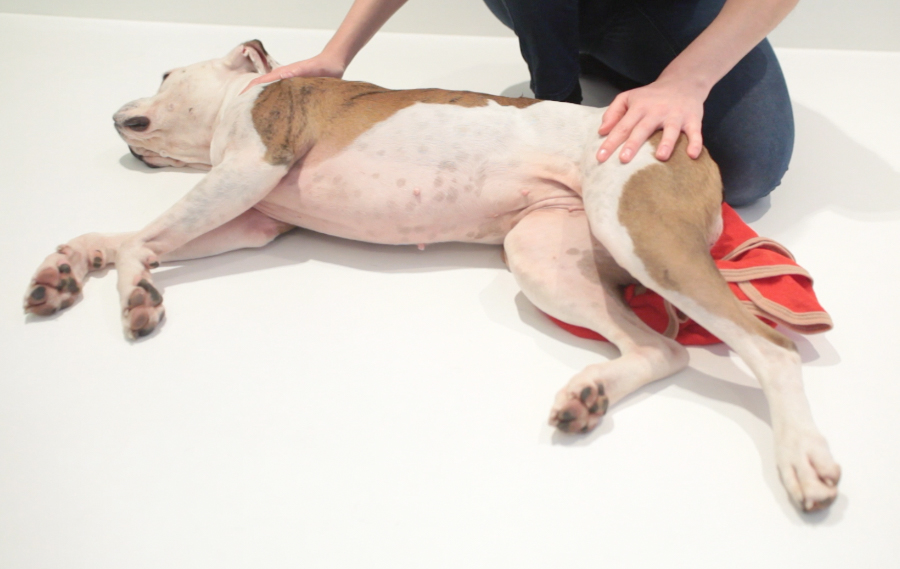
Most of us have heard of the recovery position and how important it is for humans to help keep their airway clear – but did you know that it could help save your dog’s life too? Despite all our best efforts to keep them safe, our pets do sometimes need emergency medical attention and knowing some basic first aid, including how to put them in the recovery position, could really make all the difference.
What to do if your dog is unconscious or unresponsive, but is breathing:
If you find your pet is unconscious, you first need to check if they are breathing.
To check that they are breathing, first open their airway very carefully, by pulling their tongue forward between their front teeth to clear it from the back of their throat. (please note you would never do this with a human.) Be especially careful that you do not get bitten, as if they are not fully unconscious, they may still have a bite reflex.
You should also remove their collar and anything else that could cause any form of constriction around their neck or chest and make it harder for them to breathe.
Checking that they are breathing by putting the back of your hand in front of their mouth and feeling for their breath, or putting your hand on their chest to feel for any chest movement. You could also try holding a wisp of fur in front of their nostrils to see if it moves as they exhale.
Once you have established that they are unresponsive and breathing, the best position to help them maintain an open airway is to put them into the recovery position, ideally on their side.
Extend their head back slightly to keep the tongue forward off the back of their throat and their airway clear.
Keep checking that they are breathing by putting the back of your hand in front of their mouth and feeling for their breath. You could also try holding a wisp of fur in front of their nostrils to see if it moves as they exhale. Keep checking their pulse.
To take their pulse
The easiest place to find the dog’s pulse is in the upper third of their thigh. Place your hand over the top of their thigh and gently squeeze your fingers just underneath their leg. You should be able to feel the artery pulsing here (your thumb has a strong pulse itself so don’t use this to take their pulse as otherwise you will be timing your own pulse rate). The femoral pulse can be difficult to find on pets with a greater fat covering. You can also listen for a heartbeat. Time the pulse for 15 seconds and multiply the result by 4 to get the beats per minute.
If you are concerned that they may be going into shock, raise their hind quarters slightly and keep supported so that their body remains straight; gravity encourages the tongue to flop forward and the contents of the stomach to drain out. This keeps the airway clear and allows the animal to keep breathing.
Once in the recovery position: keep checking that they are breathing.
First Aid for Pets provides this information for guidance and it is not in any way a substitute for veterinary advice. The author does not accept any liability or responsibility for any inaccuracies or for any mistreatment or misdiagnosis of any person or animal, however caused. It is strongly advised that you attend a practical First Aid for Pets course or take our online course to understand what to do in a medical emergency.
First aid class collapsed trachea in small breed
Ugh
I took my toy poodle to the vet at 2:00 AM on Thursday, March 9. She had eaten paper products and they’ve been coughing. Your vet for Scott for sure and since it’s on her way. She was no better the following day so I called our regular vet. He could not work for in until Tuesday. The x-ray showed several cardiac abnormalities, no blocks, and a strange long 7 inch piece of wooden. She refuses he placed her on cost for a sinus and prednisone, pills, diet AG, and she seem to be better. I have no one to give us a ride to the ER vet , her vet is not open until 9 AM. I have six fractured vertebrae and a fractured Elvis and re-injured my back caring for her. What on earth should I do? I am a masters prepare advanced, cardiac life for registered nurse, but I’m not familiar with a Veterinary medicine . Please help!
My 10 year old, 6 pound two is in research already to stress. I have had that twice since Thursday evening. Her breathing is very labored after eating paper products. What should I do. I cannot go anywhere and you fractured rib right and low power list. They gave me, cough medicine, prednisone, and today was the first time she began to act normal. As a masters, prepared RN, with 21 years experience, I am certain it was the prednisone I gave her the first of energy by June.