


What is the Primary Survey
The Primary Survey is a fast and systematic way to find and treat any life-threatening conditions in order of priority.
The primary Survey
Danger – Human safety always takes priority
Response – check to see if they are conscious
Airway – is their airway clear?
Breathing – are they breathing?
Circulation/ CPR
How to remember

DRABC – Action in an emergency
This section will take you through the actions required in a step-by-step guide for your quick reference in an emergency. We will cover this in more detail later to help you better understand the importance of each step.
Phone the Vet as soon as possible and always take their advice.
Danger – Human safety always stakes priority – always check it is safe for you and others.
Response – check to see if they are conscious. Approach from behind, initially touch with your foot. If no response to a foot touch, use the back of your hand (less invasive than using your palm). Touch or stroke to see if there is a response.
Airway – is their airway clear? Cautiously check in their mouth and tilt their head back to open it.
Breathing – are they breathing? – look down their body to see if they are breathing.
Circulation / CPR If they are unconscious and not breathing – give 30 chest compressions followed by 2 rescue breaths. If there has been no response in 15 minutes it is extremely unlikely that they will recover.
The Primary Survey in more detail
Danger

Be aware of anything that could fall on you, be particularly careful on roads ensuring that traffic is aware there has been an accident and you are not putting yourself at risk.
Always check for electrical cables, broken glass, chemicals and make sure you do not put yourself at risk.
Approach all injured animals with caution and remain as calm as possible. Be prepared to muzzle them if necessary. When administering to them it is best to be behind them, with their back to you if they are lying down, as they are less likely to bite from that angle.
If there is any danger – remove it. If the animal is being electrocuted, the electricity should be turned off at the mains before they are touched, otherwise you could be electrocuted as well.
USE FACE SHIELD IF YOU ARE GIVING CPR WEAR GLOVES WHEN DEALING WITH BLEEDING!
Make sure that everyone is safe. You are of no help to anyone if you become an additional casualty.
• Be very aware of potential danger.
• If necessary, carefully remove the injured animal to safety. Ideally use an improvised stretcher such as a car parcel shelf and move them as little as possible.
• Be aware that animals that are scared and in pain are far more likely to bite – stand behind them to treat them and use a muzzle if necessary.
Response
Never put yourself at risk. Establish as quickly as possible whether or not they are conscious: Approach cautiously from behind. Initially touch them gently with your foot. If there is no response when you touch with your foot, stroke them with the back of your hand. If they are floppy and there is no response: Put them on a hard, level surface on their side. Quickly check if they are still alive – Check for breathing and put them into the recovery position or start CPR accordingly.
Airway

When a cat is unconscious /unresponsive most of their muscles relax and go floppy.
The tongue is a huge muscle attached to your bottom jaw and in a cat this rolls back and can block the airway. To open a cat’s airway very carefully pull the tongue forward between the front teeth to clear it from the back of the throat. (Please note you would never do this with a human). Be especially careful that you do not get bitten.
• It is also sensible to remove their collar and anything else that could cause any form of constriction and make it harder for them to breathe
• Pull their front legs forward so they are not resting on their chest
• If you are aware of vomit or excessive amounts of saliva in their throat, you should hold them upside down to allow this to drain
• With extreme caution (do not risk being bitten) look down their throat to see if there is an obvious obstruction and if there is, very carefully try and remove it. The Heimlich manoeuvre (animal abdominal thrust) is ideal to dislodge items in an animal’s throat and this will be covered in our article on choking.
Breathing
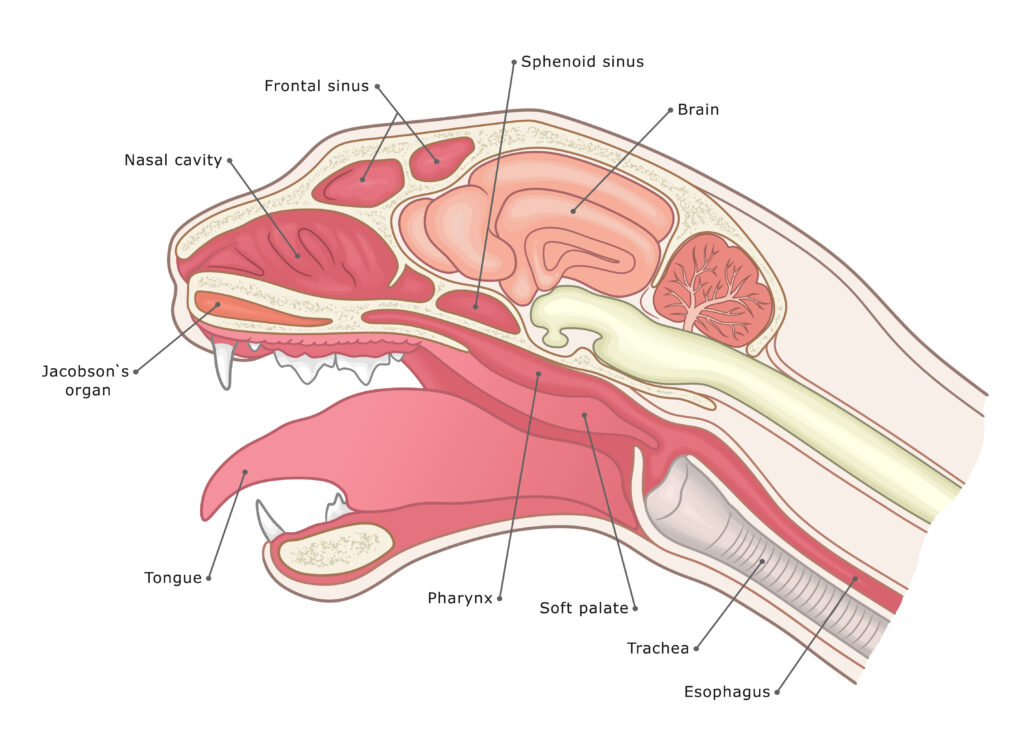
To check for breathing; if possible, lie them on their side, extend their head back and a little lower than the rest of their body, open their mouth and look at their chest movements, listen and feel to see if they are breathing. If they are unresponsive and breathing normally, keep them on their side with their head and neck extended slightly and their mouth open in an animal recovery position. If the animal is unresponsive and not breathing normally you may wish to give them artificial respiration.
Circulation
The easiest way to check for cyanosis (whether they have reduced oxygen circulating in their blood) is to look at their mucous membranes in their gums or around their eyes. If these have a blue tinge rather than being red, they are low on oxygen.
Unresponsive and Breathing
- If you are sure that they are breathing, keep them on their side, extend their head back to open their airway.
- Keep checking their pulse and breathing and call the Vet immediately.
- They will advise you the best way to move them.
- Be prepared to start CPR if they stop breathing.
Recovery position
If you are sure that they are unresponsive and breathing, the best position to help them maintain an open airway is to put them into the recovery position, on their side.
Extend their head back slightly to keep the tongue forward off the back of their throat and their airway clear. Keep checking that they are breathing, feeling their breath using the back of your hand in front of their mouth or by holding a wisp of fur in front of their nostrils to see if it moves as they exhale. Keep checking their pulse. If you are concerned that they may be going into shock, raise their hind quarters slightly raised and supported so that their body remains straight, gravity encourages the tongue to flop forward and the contents of the stomach to drain out, so as to keep the airway clear and allow the animal to keep breathing.
Once in the Recovery position: keep checking that they are breathing.
Resuscitation: CPR
When you are resuscitating, you are being a life support machine. When you push on their chest –you are being their heart. When you breathe into them – you are being their lungs.
You are keeping their heart and brain full of oxygenated blood and keeping them alive so that when you get them to the Vet there is a chance of bringing them back to life. Check for Danger, Check for Response, Open the Airway and check for Breathing.
Unconscious and not breathing
Phone the Vet!
Clear their airway; extend their neck back, pull their tongue forward and check to see if there is any obvious obstruction. Ideally lie your pet on their side. Use a Face Shield to protect yourself.
If your pet does not start breathing, then CPR will give them the best chance. Chest compressions CPR should only ever be performed on an animal that is unconscious and not breathing.
Always gain permission before performing CPR on someone else’s cat.
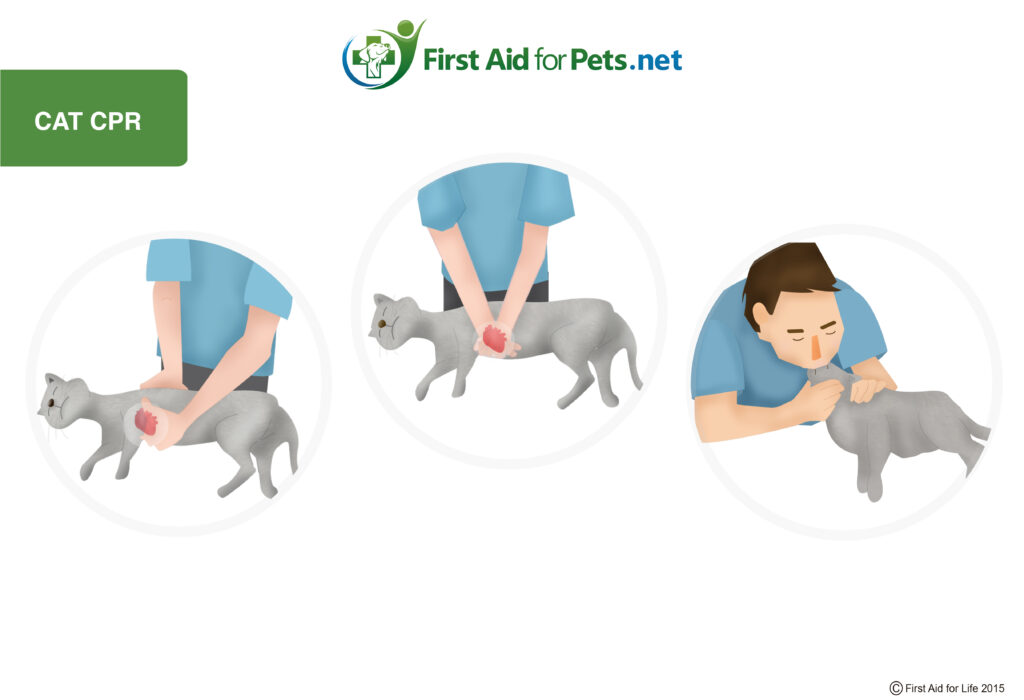
- If they are unconscious and not breathing, push on the chest just behind the front legs at a rate of about 100 to 120 times per minute
- Push down approximately a quarter to a third of their chest depth
- Give two breaths into the nose for every 30 compressions of the chest
- Keep going until at the veterinary practice – 30 compressions to 2 breaths -30:2 – 30:2 – 30:2….
- If there are two people rotate every 2 minutes to minimise fatigue
- Realistically if your pet does not recover within an absolute maximum of 20 minutes it is very unlikely they will do so. (The Blue Cross state that if they haven’t recovered within 3 minutes then recovery is incredibly unlikely)
- For most cats: lie them on their side. Place the heel of one hand in the centre of their chest above where you can normally feel their heartbeat.
First Aid for Pets provides this information for guidance and it is not in any way a substitute for veterinary advice. The author does not accept any liability or responsibility for any inaccuracies or for any mistreatment or misdiagnosis of any person or animal, however caused. It is strongly advised that you attend a practical First Aid for Pets course or take our online course to understand what to do in a medical emergency.