

When it comes to taking care of our pet friends, it is always very helpful to think in advance about how you would manage a medical emergency and to have some baseline measurements so you can quickly recognise when there is something wrong.
Remember that you should regularly practice conducting a top to toe examination on your pet.
How to start
Start with the head and systematically work down. Build up to more sensitive areas such as they eyes and other areas they may not like being scrutinised. This is really important to help avoid your pet becoming alarmed if you need to properly examine them in an emergency situation.
Regular examinations should make it easier for you to swiftly spot any abnormalities.
Nose
Their nose should be shiny and have no unusual discharge.
The texture should be kind of like a leathery bag.
It should also be relatively moist, however it can dry out whilst the dog is sleeping so this isn’t always an indicator that the nose is unhealthy.
You should also make sure that your dog is able to breath out of both nostrils.
Eyes
Look at the whites of the eye – are there any flecks? Any foreign objects?
Mouth
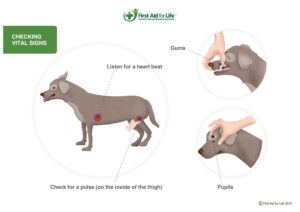
Lift up the sides of the mouth and examine the gums. They should be pink and healthy, similar to a human’s.
You can also push gently on the side of the gum. If you push down and let go, the colour should come back immediately. However if it doesn’t, this could be a sign that the dog is going into a shock (although there will be other signs).
Ears
It’s very easy for a foreign object, especially grass seeds, to become lodged in a dog’s ear, so examine the ear for anything like this.
You should also sniff the ear. If the smell is particularly bad, there may be an infection in there. But either way, it shows you whether your pet is due an ear-cleaning!
Legs
Look all over the paw, including on top – many will only examine the pads of the paws.
Moreover, look between the claws for things like grass seeds.
The claws should not be too long otherwise they can be prone to catching.
Abdomen
Your dog shouldn’t be wincing when you touch their abdomen. Have a feel all over and keep an eye on whether they seem in distress as you touch them.
You can also assess their respiratory rate as you do this – is their breathing regular? Is it speeding up or are they panting as you touch any areas?
Heart
A dog’s heart will be located just past their left leg.
You can feel or listen to their heart beat. Listen to the rate of their breathing. Just check against your watch for 15 seconds and multiply by 4. Compare to the normal rates below.
Normal range for the vital signs
Temperature: 100.5-102.5°F or 38-39.3°C
Respiratory rate: 10-30 breaths per minute
Pulse rate: 60-140bpm (smaller dogs tend to have a faster pulse rate, possibly up to 160 bpm, large dogs tend to have a slower pulse rate 60-80bpm)
Establish what is normal for your pet and keep the record safe
For a visual explanation, visit our YouTube:
Want to know more about the topic: We suggest you this article from our archive
About us
Written by Emma Hammett for First Aid for Life
Award-winning first aid training tailored to your needs
It is strongly advised that you attend a practical First Aid for Pets course or take our online course to understand what to do in a medical emergency. Please visit https://firstaidforlife.org.uk, https://www.firstaidforpets.net or call 0208 675 4036 for more information about our courses.
First Aid for Life is a multi-award-winning, fully regulated first aid training provider. Our trainers are highly experienced medical, health and emergency services professionals. They will tailor the training to your needs. Courses for groups or individuals at our venue or yours.
First Aid for Pets provides this information for guidance. It is not in any way a substitute for veterinary advice. The author does not accept any liability or responsibility for any inaccuracies or for any mistreatment or misdiagnosis of any person or animal, however caused.