

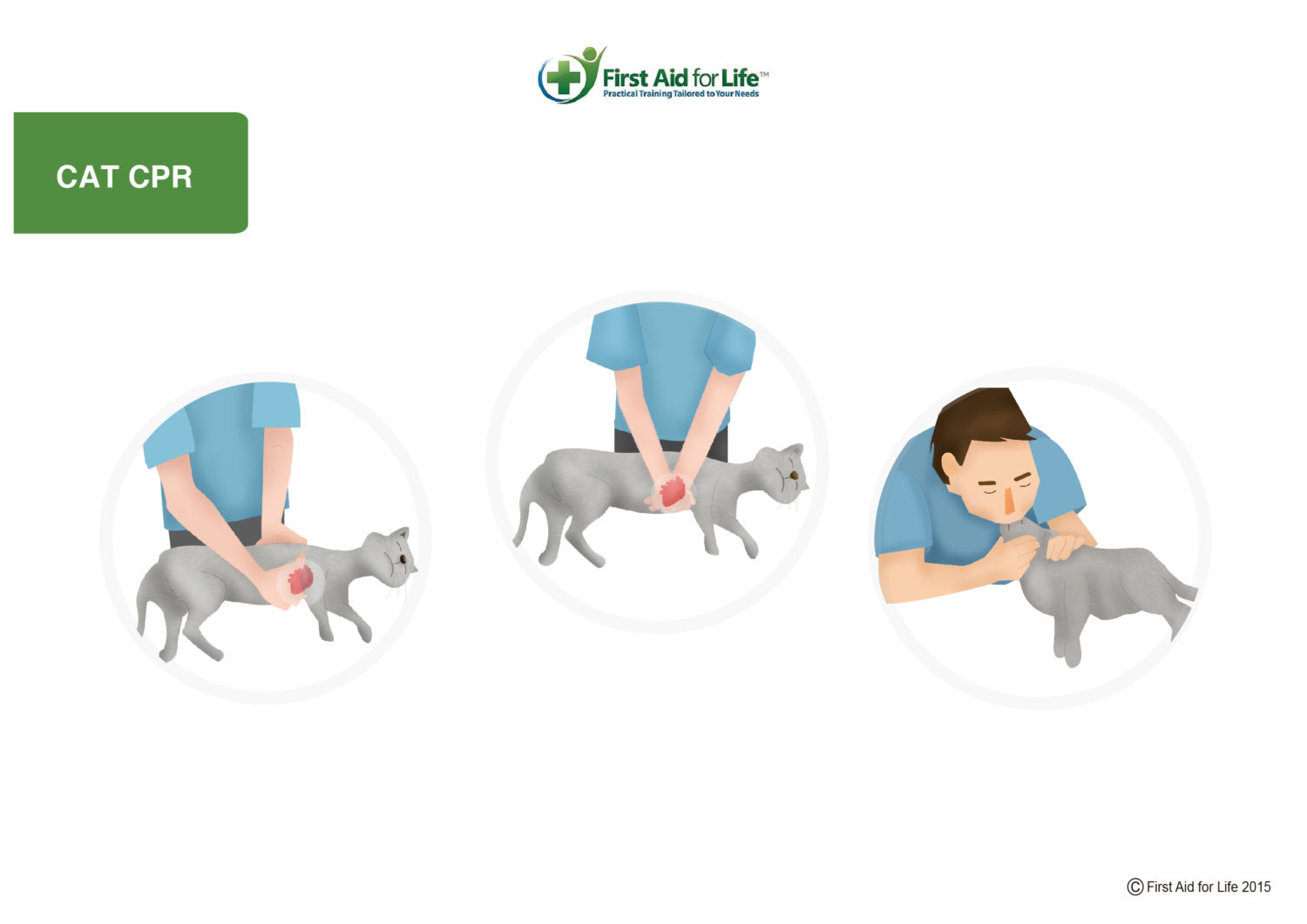
Check for danger, check for response, open the airway and check for breathing.
If a cat is unconscious and not breathing, phone the vet ASAP and do as they advise.
Resuscitation can be attempted on your own pet. However, if it is someone else’s pet it is critical that you gain full consent before you do anything to help, as pets legally belong to their owner.
Clear their airway by extending their neck back, pull their tongue forward and check to see if there is any obvious obstruction. If this does not initiate breathing, hold their mouth closed and blow into their nose about 20 times per minute.
Be extremely careful not to get bitten if the cat suddenly regains consciousness.
Giving CPR
- Give 30 chest compressions at a rate of 120 bpm
- Give 2 rescue breaths: hold their mouth shut and breathe into their nose as though you were blowing up a balloon.
- Then immediately deliver another round of 30 chest compressions.
- Remember your lungs will be much larger than a cat’s so do not over-inflate their lungs by blowing too hard. Use a face shield to protect yourself.
Chest compressions
If your pet does not start breathing, then CPR will give them the best chance: CPR should only ever be performed on an animal that is not breathing and does not have a pulse.
Always gain permission before performing CPR on someone else’s cat.
- If you cannot feel a heartbeat, push on the chest just behind the front legs at a rate of 100-120 times per minute.
- Push down approximately a quarter of their chest depth.
- Give two breaths into the nose for every 30 compressions of the chest.
- If there are two people rotate every 2 minutes as it is tiring.
- Continue 30 compressions:2 breaths, 30:2, 30:2 etc.
Realistically if your pet does not recover within 20 minutes it is very unlikely they will do so. (The Blue Cross state that if they haven’t recovered within 3 minutes then recovery is incredibly unlikely).
ALWAYS GET VETERINARY ADVICE AS QUICKLY AS POSSIBLE.
This is great to know!! Every pet owner should learn CPR for their cats and dogs as it could save their lives…I mean obv lol. I pray I never have to do this but am grateful to now know, just to be on the safe side. Thanks for this 🙂